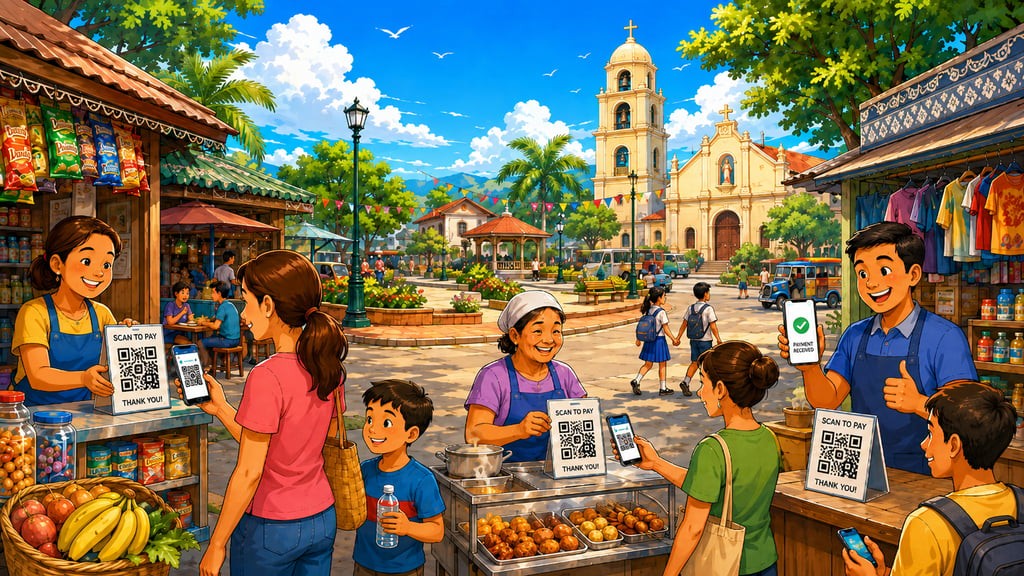
Cash will always have a place in Balangiga.
It’s simple, familiar, and still the easiest option for everyday purchases. But physical cash doesn’t have to be the only option.
Up and down the country, more people are already paying, sending, and receiving money through digital channels. According to the Bangko Sentral ng Pilipinas (BSP), digital payments made up 57.4% of monthly retail payment volume in 2024, up from just 1% in 2013.
The shift is no longer theoretical. The Philippines is already moving toward a more cash-lite economy.
Balangiga should not be left behind.
For Balangigan-ons: convenience in daily life
For residents, a digital payment option can make ordinary days easier.
A parent can send money to a child studying in Tacloban. A professional in Manila, Cebu, or abroad can send money home without needing a remittance center. Any customer in Balangiga can buy food, medicine, load, or groceries without exact cash on hand.
This is where apps like GCash and Maya become useful. They’re not just for online shopping or city life. They can help with small local transactions too: paying a sari-sari store, buying from an ukay-ukay seller, settling a food order, or sending payment to a relative.
A bank account or e-wallet also gives people a safer place to keep some money instead of carrying everything in cash.
For businesses in Balangiga: better ways to serve customers
For local businesses, accepting an electronic payment isn’t about looking modern. E-payment is meant to solve real problems.
Think of a small store that keeps running out of coins or small bills for change. A seller who takes orders through Facebook Messenger. A supplier who needs to collect payment from buyers in nearby towns.
If they accept GCash, Maya, or QR payments, customers have another way to pay.
That means fewer lost sales when someone says, “Waray ko cash yana.” or “Nakarawat kamo GCash?”
It also means the business owner can keep a clearer record of payments received during the day.
For most sellers, this matters a lot. Digital payment platforms can show when the money came in, how much was paid, and who sent it. That’s easier to track than trying to remember every cash transaction after a busy day.
For small businesses that want to become more organized, digital payments can also go hand in hand with other practical steps, such as BMBE registration for small businesses in Balangiga.
The Philippines already has momentum
This isn’t a small experiment anymore.
BSP has been actively promoting digital and interoperable payments through systems such as QR Ph, the national QR code standard, among many other initiatives.
In simple terms, a customer using a Maya app may be able to scan and pay a store’s QR Ph code, even if the store’s account is with GCash or another bank or e-wallet.
The Better Than Cash Alliance (BTCA), a United Nations-related global partnership focused on responsible digital payments, has also highlighted the Philippines as one of its member-countries making strong progress.
For instance, BTCA noted that between 2022 and 2024, merchant accounts accepting QR Ph person-to-merchant payments grew to more than 1.5 million.
That matters for towns like Balangiga. Digital payments become more useful when more people and merchants use them together.
Cash can stay. Options can grow.
Embracing digital payments doesn't mean forcing everyone to stop using cash.
Some people still prefer cash. Some don’t have smartphones. Some areas may have weak internet. Older residents may need help learning how apps work. These are real concerns.
So the goal shouldn’t be a “cashless Balangiga.”
What makes more sense is a cash-lite Balangiga.
Cash remains available, but more businesses also display a QR code. More residents learn how to use digital wallets or their bank app. More families can send money quickly. More sellers can accept payments from customers with no small bills or coins on hand.
Of course, people should be careful. Use official apps. Check the receiver’s name before sending money. Do not share OTPs. Keep PINs private.
Take small steps until you’re comfortable.
Digital payments aren’t a shortcut to prosperity. They’re simply another tool.
But for Balangiga’s shops, families, workers, students, sellers, and customers, it’s a tool worth learning.
The rest of the Philippines is already moving. Balangiga can move with it.
Balangiga.com
© 2026 Balangiga.com. All rights reserved.
Follow us: